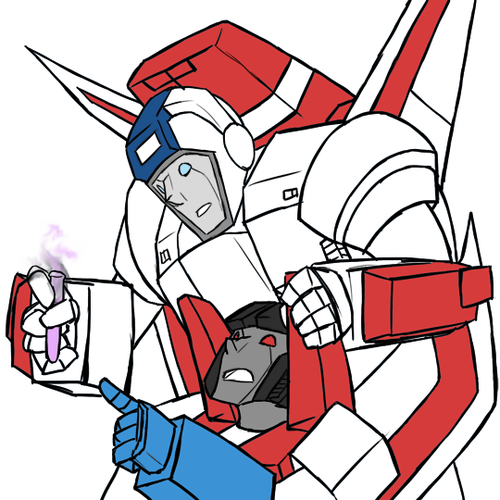
I mentioned that I was dreading rewatching “Fire in the Sky.” This, of course, is why. It’s the scene in which Starscream orders Skyfire to execute a group of Autobot prisoners as a test of his loyalty. When Skyfire refuses, claiming they have done no wrong. Starscream retorts, “But you have – traitor!” and shoots him in the chest. In the aftermath, Starscream tells the fallen Skyfire, “consider yourself fortunate that you did not end up like your *friends*.” He then stalks away, stepping over Skyfire’s body as he does so.
I don’t know about you, but I’ve always assumed this was pretty much what it appears to be: a murder attempt, which I put down to Starscream’s volatile temper getting the best of him. On this latest rewatch, though, the wording of his dialogue really jumped out at me.
Consider yourself fortunate that you did not end up like your friends.
What does this imply? Well for one thing, it implies that Starscream didn’t intend to kill Skyfire. His line is the equivalent of someone saying, “I hope you’ve learned your lesson.” In other words, Starscream’s shooting Skyfire in the chest was intended as punishment, a harsh corrective for his “diminished loyalty coefficient,” rather than attempt to kill him.
When I mentioned this thought to brilliant friend Dark, she quickly pointed out that Starscream’s shooting Skyfire in the hand in a previous scene was probably meant as a warning, and that this would match the pattern established in “More Than Meets the Eye.” During the course of that three-part episode that kicks off the series, Starscream makes two coup attempts against Megatron. Megatron punishes the first attempt by shooting Starscream in the arm, and the second by blasting him in the chest.
Is it possible that this is standard disciplinary practice among Decepticons? A warning shot for the first infraction, and a more painful, damaging one if the problematic behavior isn’t corrected? In any case, it certainly seems as if this is how Starscream is used to being dealt with by Megatron. Dark also pointed out that shooting as a punishment seems to be reserved for acts of disloyalty. I’ll have to continue my rewatch of the series to confirm this, but we did note that Starscream’s attempt to blast Thundercracker for his disloyalty in “Fire on the Mountain” would support that idea.
It’s worth noting, also, that when we do see Decepticons receive shots as a form of punishment, they don’t seem as adversely affected by it as Skyfire was. I suspect that after millions of years of being at war, Starscream is used to doling out punishments to mechs who have military-grade armor. It’s possible that when he lashed out in his anger, it didn’t occur to him that Skyfire wouldn’t have the same reinforcements.
I’ve heard it said that Starscream left Skyfire to die there on the ice, but now I question that. I don’t think he realized how badly Skyfire was hurt. There’s a later scene in which Starscream is shown back in the ice caverns, seemingly staring off into space. I’ve often wondered what he was thinking there, but now I suspect he was expecting Skyfire to come in and apologize – or simply get back to work.
Does that sound crazy? Well sure, it would seem crazy to us, but it’s what any other Decepticon on the show would have done. I think Starscream was expecting Skyfire to behave the way he, or any other Decepticon would after being punished. The idea that he might defect to the Autobots probably never even occurred to him.
Somehow, this realization has made me feel slightly better. “Fire in the Sky” certainly shows the potential in Starscream as well as his failings. Every time I watch it, it gets more painful to see the evidence that he very likely organized the Arctic energy project at least in part so that he could look for Skyfire, and I think his concern and caring for Skyfire couldn’t be more obvious. (Heck, even Megatron comments on it!)
Watching their relationship implode will always be gut-wrenching, but the thought that Starscream may not have intended things quite as they appear is… well, if not exactly comforting, then at least slightly less excruciating.
[Note: I showed this to a couple of friends before posting it, and they had some even more fascinating insights about Fire in the Sky. I may eventually have to turn this into a full-length essay! It’s amazing how the more I think about this episode, the more there seeems to be to say about it.]


 Cybertronian Database